Sight Word Worksheets

Sight Word Worksheet Generators
Create your own custom sight word worksheets in seconds using any of these popular templates:
Writing Practice
- Trace, Copy, Cover & Write - Multi-sensory approach for memorizing sight words
- Rainbow Words - Write each word in different colors for engaging practice
- Missing Letters - Fill in missing letters to reinforce spelling patterns
Games & Activities
- Sight Word Bingo - Turn review into a fun classroom game
- Word Search - Build visual discrimination skills
- Roll and Read - UFLI-inspired dice game for fluency practice
Pre-made Sight Word Lists
Start with our ready-to-use sight word lists organized by phonics pattern:
- Browse all 420+ pre-made word lists - Including multiple sight word categories
Our word lists include sight words organized by syllable type and phonics pattern, making it easy to create worksheets aligned with your scope and sequence.
Sight Word Worksheets Store
Browse ELA and early literacy worksheets perfect for sight word practice. These worksheets are designed by teachers and used in classrooms today. You can add any of them to your account and customize them for free.
To download a single worksheet, you can purchase it for $2.99. Or, purchase a full year of worksheet downloads for $29.99.
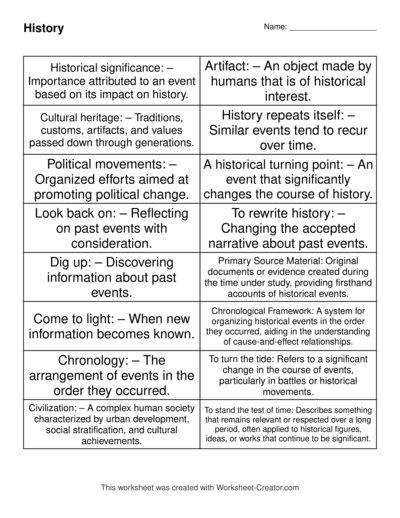
History
Words used: Historical significance: – Importance attributed to an event based on its impact on history., Cultural heritage: – Traditions, customs, artifacts, and values passed down through generations., Political movements: – Organized efforts aimed at promoting political change., Look back on: – Reflecting on past events with consideration., Dig up: – Discovering information about past events., Come to light: – When new information becomes known., Chronology: – The arrangement of events in the order they occurred., Civilization: – A complex human society characterized by urban development, social stratification, and cultural achievements., Artifact: – An object made by humans that is of historical interest., History repeats itself: – Similar events tend to recur over time., A historical turning point: – An event that significantly changes the course of history., To rewrite history: – Changing the accepted narrative about past events., Primary Source Material: Original documents or evidence created during the time under study, providing firsthand accounts of historical events., Chronological Framework: A system for organizing historical events in the order they occurred, aiding in the understanding of cause-and-effect relationships., To turn the tide: Refers to a significant change in the course of events, particularly in battles or historical movements., To stand the test of time: Describes something that remains relevant or respected over a long period, often applied to historical figures, ideas, or works that continue to be significant.
Created by: А. Патрушева
16 Words List
Words used: Historical significance: – Importance attributed to an event based on its impact on history., Cultural heritage: – Traditions, customs, artifacts, and values passed down through generations., Political movements: – Organized efforts aimed at promoting political change., Look back on: – Reflecting on past events with consideration., Dig up: – Discovering information about past events., Come to light: – When new information becomes known., Chronology: – The arrangement of events in the order they occurred., Civilization: – A complex human society characterized by urban development, social stratification, and cultural achievements., Artifact: – An object made by humans that is of historical interest., History repeats itself: – Similar events tend to recur over time., A historical turning point: – An event that significantly changes the course of history., To rewrite history: – Changing the accepted narrative about past events., Primary Source Material: Original documents or evidence created during the time under study, providing firsthand accounts of historical events., Chronological Framework: A system for organizing historical events in the order they occurred, aiding in the understanding of cause-and-effect relationships., To turn the tide: Refers to a significant change in the course of events, particularly in battles or historical movements.
Created by: А. Патрушева
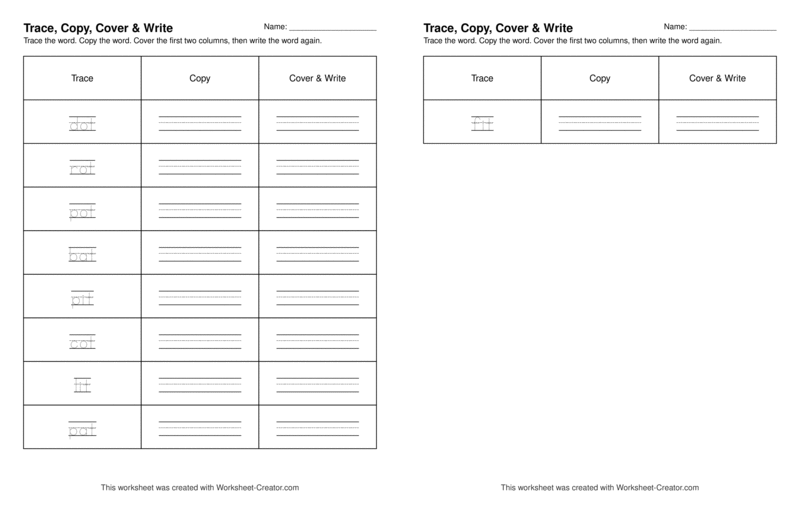
Trace, Copy, Cover & Write
Words used: dot, rot, pot, bat, pit, cot, lit, pat, fit
Created by: T. Rubman
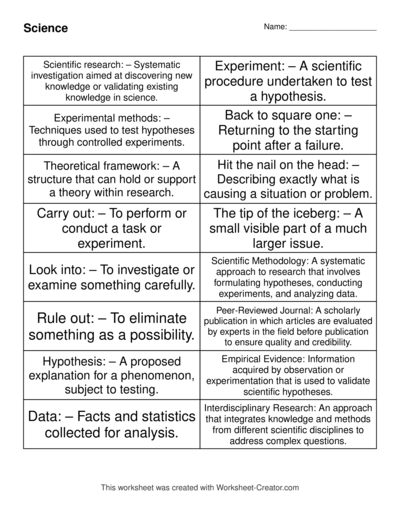
Science
Words used: Scientific research: – Systematic investigation aimed at discovering new knowledge or validating existing knowledge in science., Experimental methods: – Techniques used to test hypotheses through controlled experiments., Theoretical framework: – A structure that can hold or support a theory within research., Carry out: – To perform or conduct a task or experiment., Look into: – To investigate or examine something carefully., Rule out: – To eliminate something as a possibility., Hypothesis: – A proposed explanation for a phenomenon, subject to testing., Data: – Facts and statistics collected for analysis., Experiment: – A scientific procedure undertaken to test a hypothesis., Back to square one: – Returning to the starting point after a failure., Hit the nail on the head: – Describing exactly what is causing a situation or problem., The tip of the iceberg: – A small visible part of a much larger issue., Scientific Methodology: A systematic approach to research that involves formulating hypotheses, conducting experiments, and analyzing data., Peer-Reviewed Journal: A scholarly publication in which articles are evaluated by experts in the field before publication to ensure quality and credibility., Empirical Evidence: Information acquired by observation or experimentation that is used to validate scientific hypotheses., Interdisciplinary Research: An approach that integrates knowledge and methods from different scientific disciplines to address complex questions.
Created by: А. Патрушева
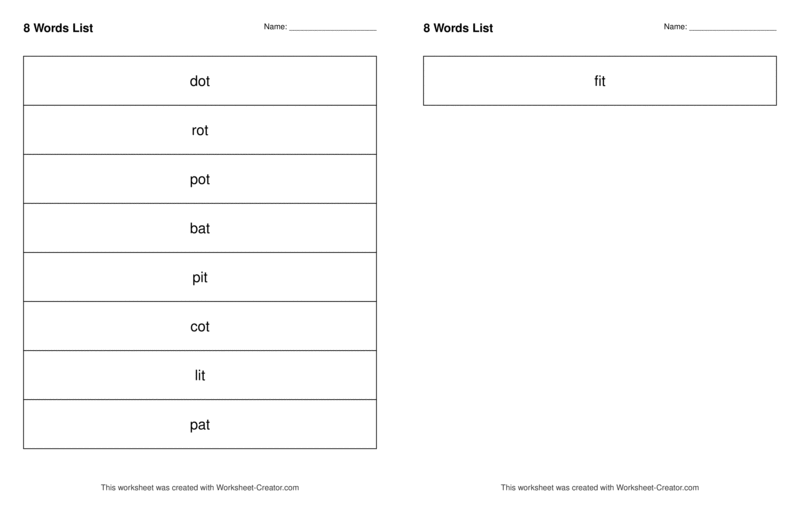
8 Words List
Words used: dot, rot, pot, bat, pit, cot, lit, pat, fit
Created by: T. Rubman
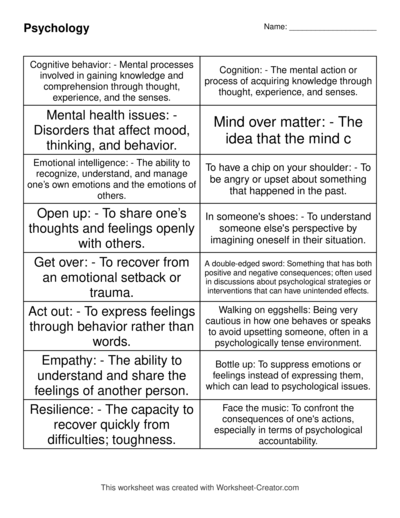
Psychology
Words used: Cognitive behavior: - Mental processes involved in gaining knowledge and comprehension through thought, experience, and the senses., Mental health issues: - Disorders that affect mood, thinking, and behavior., Emotional intelligence: - The ability to recognize, understand, and manage one’s own emotions and the emotions of others., Open up: - To share one’s thoughts and feelings openly with others., Get over: - To recover from an emotional setback or trauma., Act out: - To express feelings through behavior rather than words., Empathy: - The ability to understand and share the feelings of another person., Resilience: - The capacity to recover quickly from difficulties; toughness., Cognition: - The mental action or process of acquiring knowledge through thought, experience, and senses., Mind over matter: - The idea that the mind c, To have a chip on your shoulder: - To be angry or upset about something that happened in the past., In someone's shoes: - To understand someone else's perspective by imagining oneself in their situation., A double-edged sword: Something that has both positive and negative consequences; often used in discussions about psychological strategies or interventions that can have unintended effects., Walking on eggshells: Being very cautious in how one behaves or speaks to avoid upsetting someone, often in a psychologically tense environment., Bottle up: To suppress emotions or feelings instead of expressing them, which can lead to psychological issues., Face the music: To confront the consequences of one's actions, especially in terms of psychological accountability.
Created by: А. Патрушева
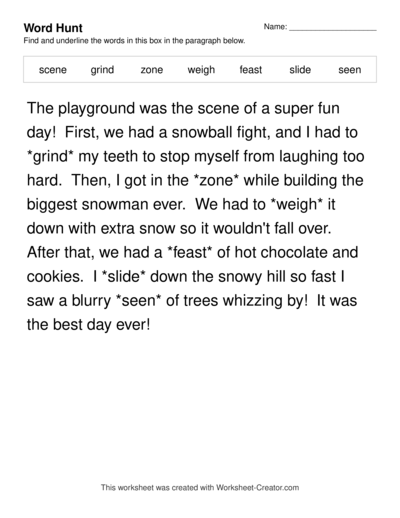
Word Hunt
Words used: scene, grind, zone, weigh, feast, slide, seen, crow, clue
Created by: T. Rubman
Write 5 Sentences
Words used: scene, grind, zone, weigh, feast, slide, seen, crow, clue
Created by: T. Rubman
_image_1744023661.png)
Draw and Label
Words used: scene, grind, zone, weigh, feast, slide, seen, crow, clue
Created by: T. Rubman
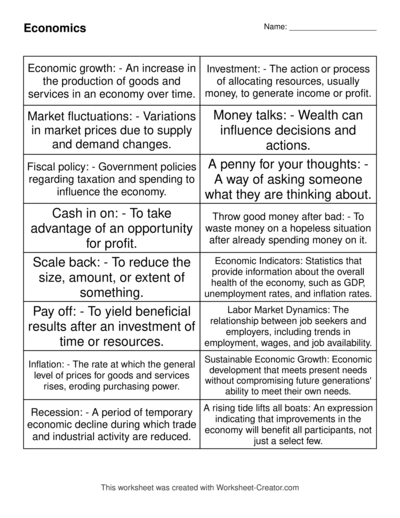
Economics
Words used: Economic growth: - An increase in the production of goods and services in an economy over time., Market fluctuations: - Variations in market prices due to supply and demand changes., Fiscal policy: - Government policies regarding taxation and spending to influence the economy., Cash in on: - To take advantage of an opportunity for profit., Scale back: - To reduce the size, amount, or extent of something., Pay off: - To yield beneficial results after an investment of time or resources., Inflation: - The rate at which the general level of prices for goods and services rises, eroding purchasing power., Recession: - A period of temporary economic decline during which trade and industrial activity are reduced., Investment: - The action or process of allocating resources, usually money, to generate income or profit., Money talks: - Wealth can influence decisions and actions., A penny for your thoughts: - A way of asking someone what they are thinking about., Throw good money after bad: - To waste money on a hopeless situation after already spending money on it., Economic Indicators: Statistics that provide information about the overall health of the economy, such as GDP, unemployment rates, and inflation rates., Labor Market Dynamics: The relationship between job seekers and employers, including trends in employment, wages, and job availability., Sustainable Economic Growth: Economic development that meets present needs without compromising future generations' ability to meet their own needs., A rising tide lifts all boats: An expression indicating that improvements in the economy will benefit all participants, not just a select few.
Created by: А. Патрушева
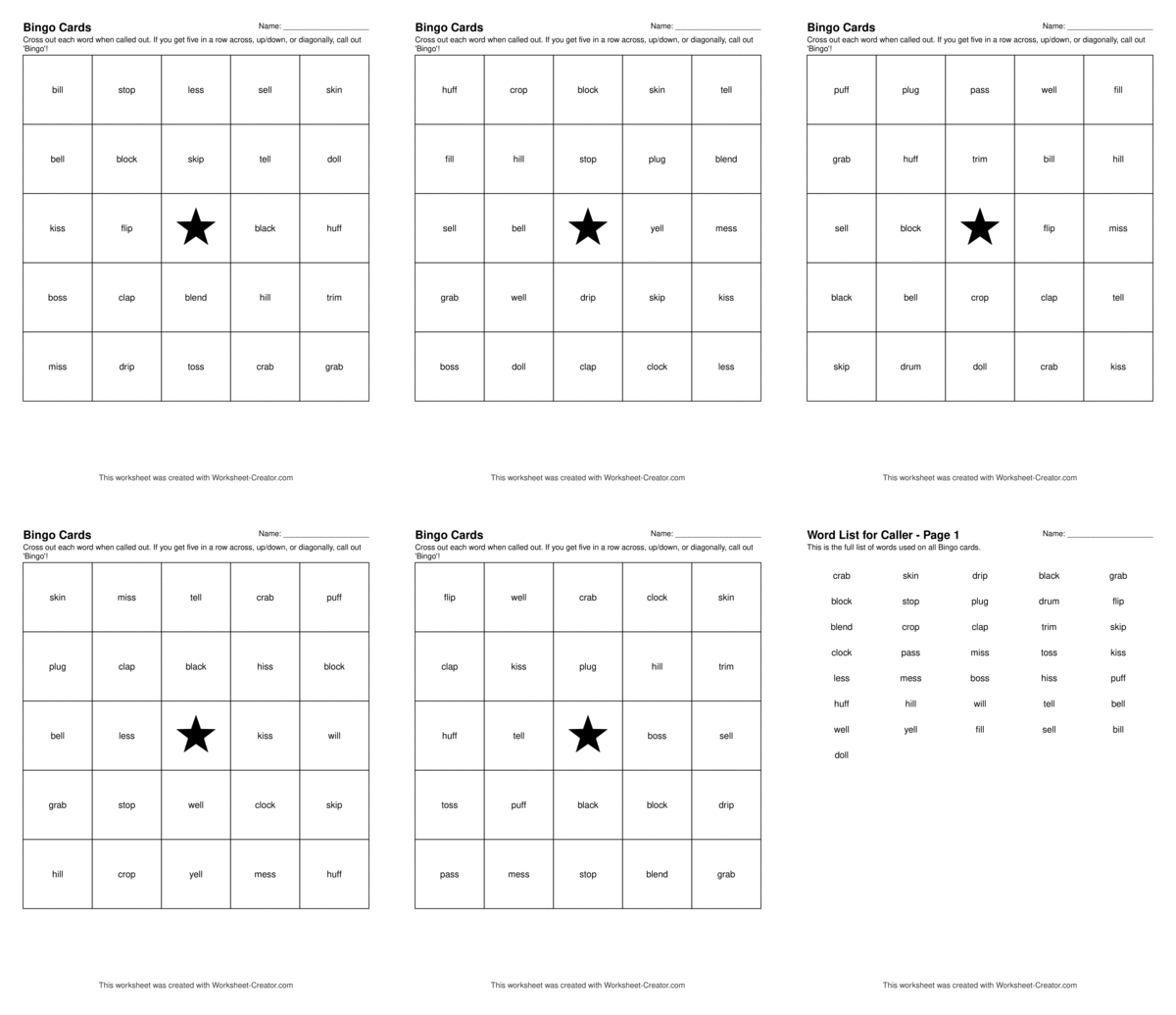
Bingo Cards
Words used: crab, skin, drip, black, grab, block, stop, plug, drum, flip, blend, crop, clap, trim, skip, clock, pass, miss, toss, kiss, less, mess, boss, hiss, puff, huff, hill, will, tell, bell, well, yell, fill, sell, bill, doll
For grade level: ParentHomeschool
Created by: K. Cole
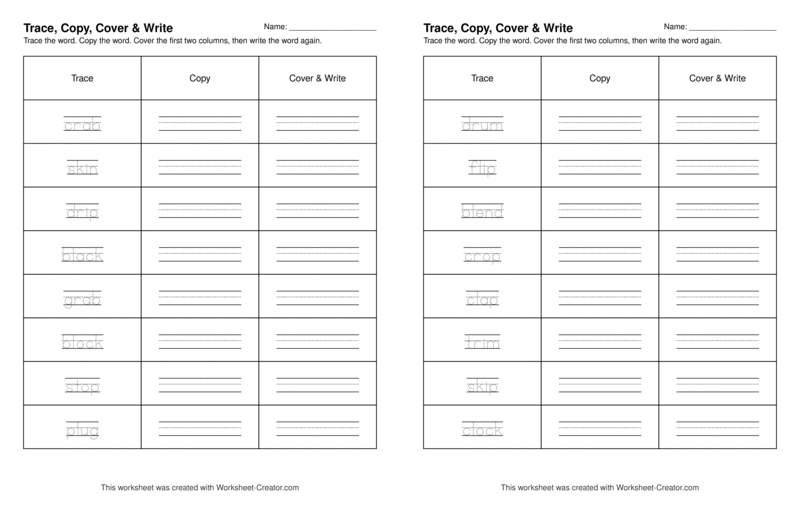
Trace, Copy, Cover & Write
Words used: crab, skin, drip, black, grab, block, stop, plug, drum, flip, blend, crop, clap, trim, skip, clock
For grade level: ParentHomeschool
Created by: K. Cole
What Are Sight Words?
Sight words (also called high-frequency words) are words that appear frequently in written text. Many don't follow regular phonics patterns, so students need to recognize them instantly "by sight." The two most common sight word lists are:
- Dolch Words: 220 high-frequency words organized into five grade levels (Pre-primer through Grade 3)
- Fry Words: 1,000 words organized into groups of 100, with the first 300 covering about 65% of all written material
When students can recognize these words automatically, they can focus on comprehension rather than decoding.
Tips for Teaching Sight Words
- Introduce 3-5 words per week: Small groups allow for the repetition needed for mastery
- Use multi-sensory approaches: Combine seeing, saying, tracing, and writing
- Practice in context: Have students find sight words in sentences and books
- Review regularly: Use Bingo and Roll and Read with mixed new and review words
- Make it fun: Games keep students engaged during repetitive practice
For more detailed strategies, read our complete guide: How to Create Sight Word Worksheets in Seconds.
Conclusion
Sight word fluency is essential for reading success. With Worksheet Creator, you can create professional, customized sight word worksheets in seconds. Choose from Trace Copy Cover Write for multi-sensory learning, Bingo for game-based review, or any of our other templates to match your students' needs.