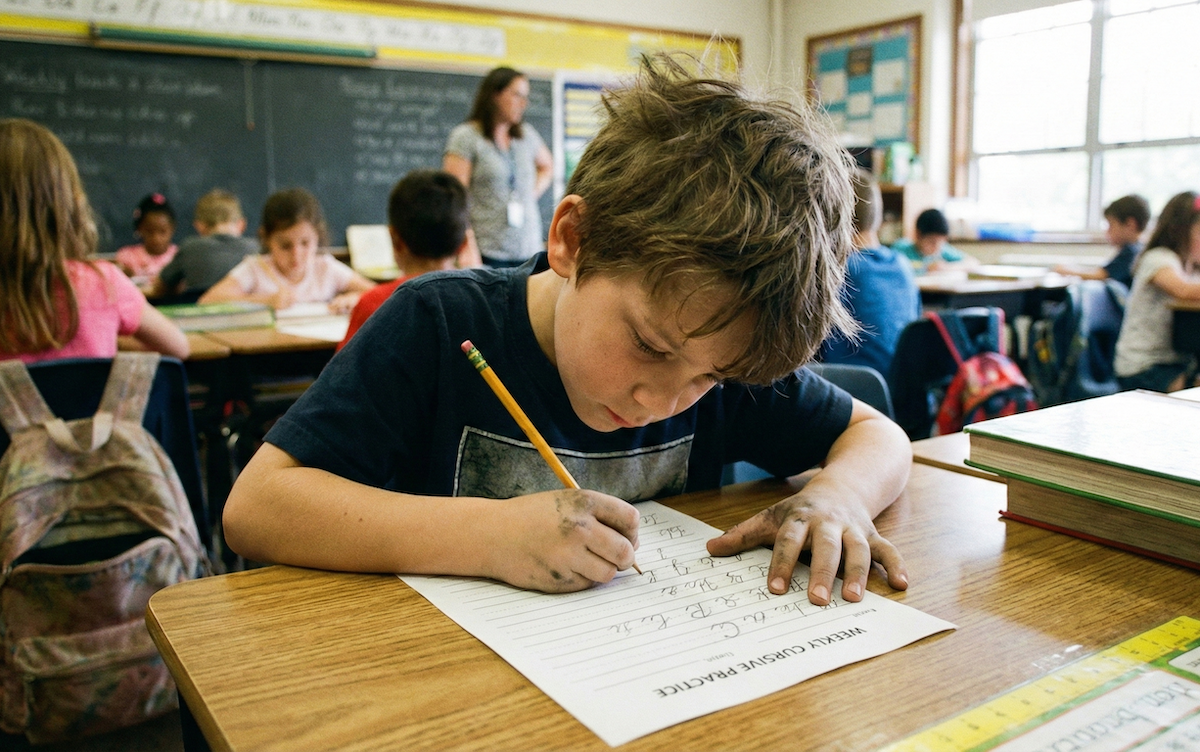
In an era dominated by touchscreens and keyboards, handwriting remains one of the most critical developmental skills for students. Far from being an outdated relic, research shows that the act of writing by hand engages the brain in ways that typing does not.
From developing fine motor skills in Kindergarten to retaining complex lecture notes in High School, handwriting is the foundation of literacy and critical thinking.
This guide explores the research-backed benefits of handwriting for every grade level, makes the case for cursive handwriting, and provides actionable strategies and tools to improve your students' penmanship, reading, and writing outcomes.
The Meta-Analysis of Fine Motor Skills benefits
Let's start by looking at the link between fine motor skills, handwriting, and academic success.
Suggate, et. al. conducted a meta-analysis of the benefits of handwriting and Fine Motor Skills in general, across over 21,000 studies. They looked for corrections between specific types of fine motor skills:
- Dexterity: Object manipulation (e.g., pegboards)
- Graphomotor: Using a tool (pen/pencil) to draw symbols
- Speed: Rapid movements (tapping)
- Finger Gnosia: Proprioception
- The link is moderate to strong: Fine Motor Skills and academic success are significantly linked.
- It persists with age: The link exists in older students (adolescents) just as much as in young children. It is not just a developmental phase.
- Tool use matters most: Among all FMS, Graphomotor skills (using a pen/pencil) are more important for academic success than simple dexterity (moving pegs). There is a cognitive benefit to using a tool to create a symbol vs simply manipulating an object.
This graphomotor advantage is significant because handwriting requires hand-eye coordination that activates multiple brain regions simultaneously. Unlike typing, which involves repetitive keystrokes, the act of physically forming letters by hand forces the brain to process and summarize information rather than simply transcribing it. Once letter formation becomes automatic, cognitive resources can shift to higher-order tasks like composition, idea expression, and narrative development.9
The Developmental Benefits of Handwriting by Grade Level
Handwriting is not just about legibility; it is about cognitive development. Here is what the research says about the impact of handwriting at different stages of education.
Kindergarten: Fine Motor Skill and Letter Recognition Development
At this stage, writing is a physical workout for the brain. According to research using fMRI scans by Dr. Karin James at Indiana University, children who physically write letters show increased activity in the brain's reading network compared to those who simply watch or type them. A "reading circuit" was recruited during letter perception only after handwriting, not after typing or tracing experience. This shows that handwriting is important for the early recruitment in letter processing of brain regions known to underlie successful reading.
Additional research confirms that physically forming letters strengthens memory and accelerates learning. Studies comparing handwriting and typing groups found that children in handwriting groups achieved higher accuracy across all tasks, demonstrating that tracing out letters leads to better and longer-lasting recognition and understanding compared to typing them.
- Benefit: Writing by hand activates a "reading circuit", which leads to better reading skills in young learners.
- Benefit: Physical letter formation creates stronger, more lasting memory traces than typing or passive observation.
Grades 1-5: The Literacy Link
This is the critical window for "automaticity"—the ability to write without conscious thought. Dr. Virginia Berninger's research explains the role of the orthographic loop between the mind's eye and the movement of the hand in engaging the mind in the written expression of ideas, the importance of automatic access to be able to produce legible letters, and the contribution of handwriting as a fundamental skill for spelling and composing.
- Benefit: Cursive writing connects letters, which inhibits the reversal of letters (common in dyslexia) and encourages a continuous flow of thought.
Grades 6-8: Retention and Comprehension
Middle school is often the first time students are required to take notes during lectures. A famous research study, "The Pen is Mightier Than the Keyboard" by Mueller and Oppenheimer (2014) indicates that students who write notes by hand perform significantly better on conceptual questions than those who type. Students who type tend to transcribe lectures verbatim because typing is faster. This bypasses the brain's processing centers. Students who handwrite cannot write fast enough to transcribe, so they are forced to listen, digest, summarize, and rephrase the content in real-time. This process, known as "generative note-taking," builds neural pathways for understanding.
- Benefit: Students retain conceptual information better when writing notes by hand. This process, known as "generative note-taking," builds neural pathways for understanding.
High School: Critical Thinking and Improved Recall
For high schoolers, handwriting is a tool for critical thinking. We know from the study mentioned earlier, "The Pen Is Mightier Than the Keyboard" (Mueller & Oppenheimer), that students who took handwritten notes performed significantly better on conceptual questions than those who used laptops. This finding has been reinforced through EEG-traced brain activity research by F. R. (Ruud) Van der Weel and Audrey L. H. Van der Meer from the Developmental Neuroscience Laboratory at the Norwegian University of Science and Technology, Trondheim, Norway, where 36 students wearing EEG caps showed that taking notes by hand, sketching diagrams, writing summaries and so forth trumps keyboarding for tasks meant to achieve deep understanding or long-term retention.
- Benefit: Handwriting facilitates deep processing of information and greater recall. This is essential for increasing writing endurance as well as retention of information-dense High School level content.
The benefits of Cursive Handwriting

While the debate over cursive often centers on tradition versus modernity, research shows that writing in cursive stimulates the brain in ways that printing and typing do not. The unique requirement of connecting letters creates specific neural pathways beneficial for literacy and motor control, while also showing to be beneficial for students with dyslexia.
Dr. Virginia Berninger's research found that printing, cursive writing, and typing all engage different brain systems. Cursive does not merely duplicate the skills of printing; it trains the brain to integrate visual and tactile information differently. Cursive requires a higher level of fine motor coordination and "movement control" than printing. It links the visual recognition of the letter with the physical sensation of the flow, aiding in better letter recognition.
Cursive writing is also a faster method of writing than printing, which increases writing endurance and reduces hand fatigue during long writing sessions. When a student can write faster (fluency), their hand can keep up with their train of thought. This prevents the "bottleneck" effect where a student forgets an idea before they can finish writing the sentence.
For students with dyslexia, cursive writing can be particularly beneficial. Research indicates that cursive can help students with dyslexia because the continuous movement prevents letter reversals (like confusing 'b' and 'd'). Furthermore, the flow from left to right reinforces directionality, which further limits letter reversals. The connected, fluid strokes also make writing more manageable and less fragmented, as the continuous motion reduces the fine-motor demands of repeatedly lifting the pencil, helping learners process words as unified units.
We provide specialized tools for Cursive Handwriting Practice to help students master connected text alongside standard print.
Proven Handwriting Activities & Worksheets
To move from theory to practice, you need effective tools. Here are a few time-tested, research-backed worksheet activities that you can create on Worksheet Creator.
1. Trace Copy Cover Write
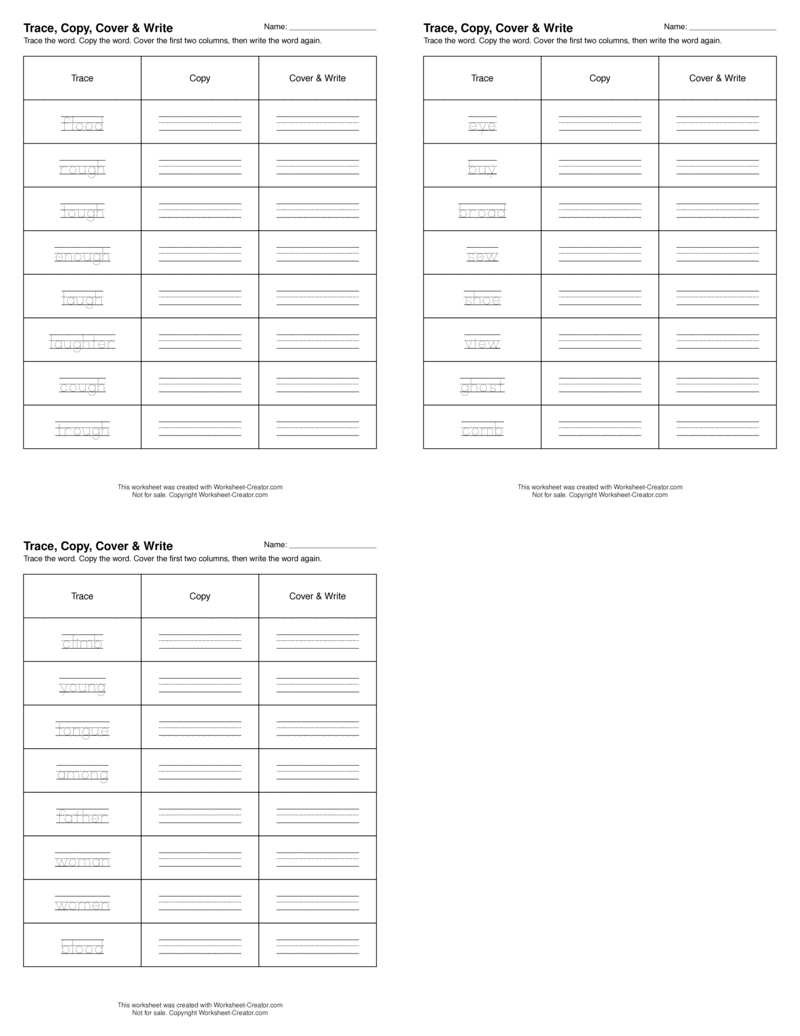
This worksheet activity scaffolds the process of writing a word by starting with tracing, moving to copying, and finally writing from memory. It helps students build confidence in their writing skills. Trace, copy, cover & write (also known as Trace, Copy, Cover & Closed, TCCCC) is a great technique for children in grades Kindergarten to 3rd grade to use in the classroom and at home when practicing spelling. Teachers can use this method to help students reinforce their weekly words and overcome any spelling errors they may have made in writing work.
- Best for: Grades K-3.
- Learn more: Trace Copy Cover Write
- Create a worksheet: Trace Copy Cover Write Worksheet Generator
2. Look Say Cover Write Check
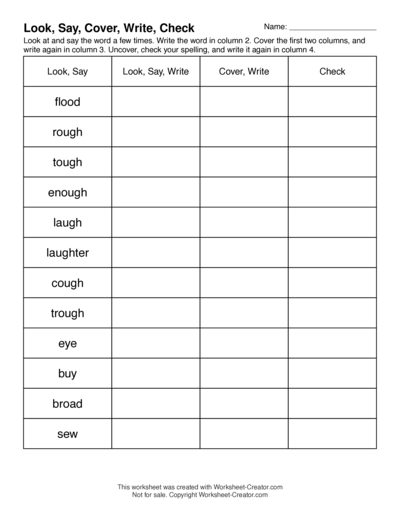
This method integrates auditory, visual, and kinesthetic learning. It is particularly effective for spelling retention because it forces the student to visualize the word in their "mind's eye" before writing it. It is a great technique for children in Kindergarten to 3rd grade to use in the classroom and at home when practicing spelling. The student:
- Studies the word
- Says it aloud a few times
- Writes it into the second column while saying it aloud again
- Cover the first two columns with a piece of paper
- Writes the word again in the third column
- Uncover and checks to see if they got it right. If not, writes the word again in the fourth column
- Best for: Grades K-3.
- Learn more: Look Say Cover Write Check
- Create a worksheet: Look Say Cover Write Check Worksheet Generator
3. Rainbow Words
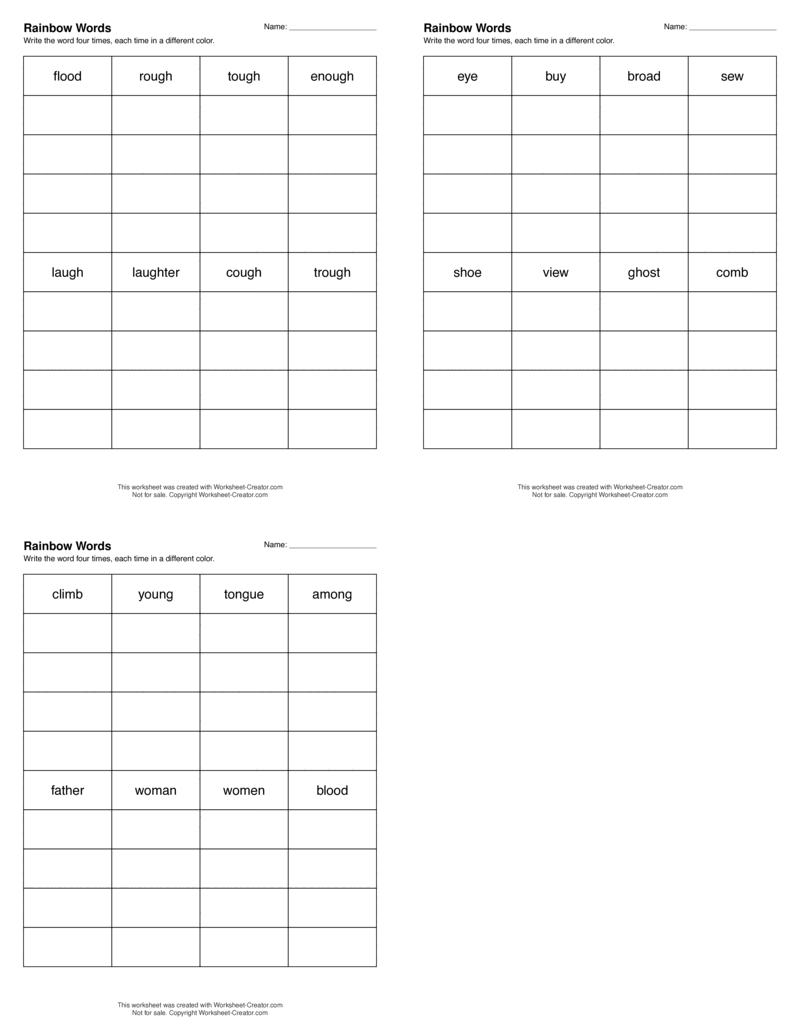
Engagement is key to practice. Rainbow writing involves tracing over the same word multiple times using different colored pencils or markers. It turns repetitive drilling into an art project, increasing time-on-task without boredom. The student:
- Writes each word four times in different boxes
- Uses a different color for each word. Or, they can use a different color for each letter of the word
- Gets creative with their color choices
- Practices reading the word as they write it
- Best for: Grades K-3.
- Learn more: Rainbow Words
- Create a worksheet: Rainbow Words Worksheet Generator
4. Dedicated Cursive Practice
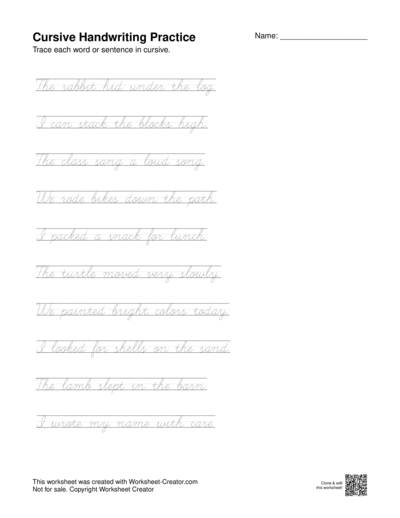
Cursive Handwriting Practice is a worksheet template designed to help students practice writing in cursive. Many teachers prefer to create Cursive activity worksheets with phrases instead of single words, to create additional opportunities to practice connecting words. Each word or phrase is printed on a separate line, allowing students to trace and practice writing in cursive handwriting. Some worksheets will actually repeat the same phrase multiple times, to help students build muscle memory and see their own improvements with each iteration. Cursive Handwriting Practice is great for students in grades 2-5, but we've also seen some teachers use it for older students in homeroom in middle school and even high school.
- Best for: Grades 3-5.
- Learn more: Cursive Handwriting Practice
- Create a worksheet: Cursive Handwriting Practice Worksheet Generator
How to Teach Handwriting Effectively
Teaching handwriting requires more than handing a student a pencil. Here are the three pillars of effective instruction:
- Posture and Grip First: Before the pencil hits the paper, ensure the student is sitting with feet flat, back straight, and paper tilted (left for right-handers, right for left-handers). Correct a "death grip" early to prevent hand fatigue.
- Short, Frequent Bursts: Research shows that 10–15 minutes of daily practice is far superior to a single hour-long session once a week. Muscle memory is built through frequency, not intensity.
- Group Similar Letters: Don't teach A-Z in order. Teach letters by their stroke families.
- Clock Climbers: a, d, g, q, c
- Kite Strings: i, u, w, t, j
- Loop Group: h, k, b, l, e
There are a number of YouTube videos that show how to teach handwriting effectively. Here is one example:
Strategies to Encourage Handwriting
In a digital world, students often ask, "Why do I have to write this?" Here is how to foster a love for the pen:
- Real-World Application: Have students write physical thank-you notes, grocery lists, or birthday cards. When writing has a social purpose, students care more about legibility.
- The Right Tools: Sometimes, a special grip, a smooth-writing gel pen, or high-quality paper can make the sensory experience of writing enjoyable rather than a chore.
- Celebrate Progress, Not Perfection: Use our Trace Copy Cover Write tools to show students their progress. Keep a sheet from the start of the year and compare it to one from the middle of the year. The visual proof of improvement is a massive motivator.
- Gamify It: Use Rainbow Words to make the practice visually stimulating and fun.
Ready to help your students improve handwriting, cursive, writing and reading?
Start creating custom, research-backed handwriting resources today. Whether you need cursive practice for a 4th grader or rainbow words for a kindergartner, we have the tools you need.
References
- James, K. H., & Engelhardt, L. (2012). The effects of handwriting experience on functional brain development in pre-literate children. Trends in Neuroscience and Education.
- Graham, S., et al. (1997). The relationship between handwriting style and speed and legibility. Journal of Educational Research.
- Berninger, V. W. (2009). Evidence-based, developmentally appropriate writing skills K to 5: Teaching the Orthographic Loop of Working Memory to Write Letters, Spell Words, and Express Ideas. Elementary School Journal.
- Berninger, V. W., et al. (2006). "Early development of language by hand: Composing, reading, listening, and speaking connections; three letter-writing modes; and fast mapping in spelling." Developmental Neuropsychology.
- Mueller, P. A., & Oppenheimer, D. M. (2014). The Pen Is Mightier Than the Keyboard: Advantages of Longhand Over Laptop Note Taking. Psychological Science.
- Van der Weel FR and Van der Meer ALH (2024) Handwriting but not typewriting leads to widespread brain connectivity: a high-density EEG study with implications for the classroom. Front. Psychol. 14:1219945. doi: 10.3389/fpsyg.2023.1219945
- Montgomery, D. (2012). "The role of handwriting in the discovery, diagnosis and remediation of dyslexia."
- Suggate, S. P., Karle, V. L., Kipfelsberger, T., & Stoeger, H. (2025). Keep the hands in mind: A meta-analysis of correlations between fine motor skills and reading, writing, mathematics, and cognitive development in children and adolescents. Educational Research Review, 49, 100748. https://doi.org/10.1016/j.edurev.2025.100748
- Jacobs, J. (2025). Handwriting is linked to learning, memory and thinking. Joanne Jacobs. https://www.joannejacobs.com/post/handwriting-is-linked-to-learning-memory-and-thinking