Morphology is the hidden architecture of language—the study of how words are built from meaningful parts called morphemes. Understanding morphology helps students unlock thousands of words, improve reading comprehension, and develop stronger spelling skills. We've created a collection of morphology word matrix worksheets for common Latin roots to help you get started.
This guide explores what morphology is, why it matters for literacy instruction, and provides practical strategies and tools to help your students master word structure.
What is Morphology?
- Definition: Morphology is the branch of linguistics that focuses on the structure and formation of words in a language. It is the study of how morphemes are combined to form words.
- Context: Morphology is a critical set of concepts that define the structure of language.
- Linguistic Context: English is a morphophonemic language.
What is a Morpheme?
A morpheme is the smallest unit of a word that holds meaning. Unlike a phoneme (the smallest unit of sound), a morpheme carries meaning and contributes to the overall sense of a word. Morphemes cannot be divided further without losing the sense they contribute to the word.
Morphological Awareness is the ability to consciously recognize, comprehend, and manipulate these morphemes. This awareness is vital because it turns word learning from a passive process into an intentional, self-directed one.
Why Morphology Instruction is Essential for Literacy
Improves vocabulary development
- Understanding morphemes (prefixes, roots, and suffixes) helps students deduce the meaning of unfamiliar words.
- Morpheme knowledge allows students to access thousands of words. This particularly useful when they encounter a newly constructed word based on a prefix they already know or have studied.
- Explicit vocabulary instruction (Direct Instruction) is verified as effective, particularly for struggling readers.
- Expanding the size and depth of a student's vocabulary is consistently linked to higher levels of reading comprehension.
Enhances Reading Comprehension
Morphological awareness enhances reading comprehension because it provides a necessary strategy to break down complex words into manageable parts. Middle school texts, for example, are rich with long, multisyllabic, and specialized words such as photosynthesis, independence, and revolutionary. Without effective strategies for breaking these words into parts, students may stumble or guess, which interferes with comprehension.
Supports Spelling and Encoding Skills
Students can improve their spelling abilities by learning word patterns and structures. Writing is important because it reinforces decoding through encoding the word, helping to cement it in the student’s mind and strengthen long-term retention.
Promotes Independent Word Learning
While using context clues is a good strategy, middle and high school students need multiple strategies and the ability to know when to use them. When context clues are not sufficient or available, the reader must use a different strategy, such as analyzing morphemes (the “inside the word” strategy). Morphological analysis encourages critical thinking about language usage.
The Components of Morphemes
Types of Morphemes: Free vs. Bound
Morphemes are categorized based on whether they can stand alone as a word:
- Free Morphemes: These can be a word all on their own (e.g., cat, walk, school).
- Bound Morphemes: These cannot be a word on their own and must be attached to another morpheme (e.g., un-, -ed, or the base struct).
Bases and Roots
- Base Word: This is the core of the word and holds the bulk of the word’s meaning. A base can be free (e.g., cat) or bound (e.g., struct).
- Root: This term often refers to the etymological source of a base, tracing back to older languages like Latin or Greek, acting as the historical “seed” from which many English words grow.
Affixes: Prefixes and Suffixes
Affixes are bound morphemes that are added to the beginning or end of a base word or root to change that word.
Prefixes
Prefixes are affixes attached before a base word. They modify the meaning of words by negating, intensifying, or changing the direction.
- The 20 most common prefixes (un-, re-, in/im/il/ir-, dis-, etc.) account for 97% of all prefixed words in English.
- Instruction on the most common prefixes is highly recommended as the first component of word analysis.
Suffixes
Suffixes are affixes attached after a base. There are two types:
- Inflectional Suffixes: These change the verb tense, pluralize nouns, or show comparison, but they do not change the part of speech (e.g., -ed, -s, -er, -est).
- Derivational Suffixes: These create a new word and often change the part of speech (e.g., -tion, -able).
- The 10 most common suffixes (-s/-es, -ed, -ing, -ly, etc.) account for 95% of all suffixed words in English.
Suffix Changing Conventions
Unlike prefixes, adding suffixes can cause the base word to change spelling, but these changes happen in consistent, predictable ways. Vowel suffixes often cause changes to be made to the base word.
Key rules include:
- The Dropping Rule: When a word ends with a silent e, that e must be dropped before adding a vowel suffix (e.g., hope + -ing becomes hoping). The e is generally not covered or dropped when adding the suffix -s.
- The Doubling Rule (1:1:1 Rule): This rule applies to a one-syllable word that has one vowel followed by one consonant when adding a vowel suffix, prompting the speller to double the final consonant (e.g., run + -ing becomes running).
- The Suffix -ed Pronunciation: The suffix -ed has three distinct pronunciations: /d/, /t/, and /id/. It is helpful to explicitly point this out to students.
Teaching Strategies and Classroom Activities
Instructional Sequence
Morphology instruction can begin early; you can start teaching it orally in kindergarten. While we haven't seen a well-established scope and sequence plan for teaching morphology, here are the general guidelines we've encountered:
- Early Elementary (K-2): Start teaching morphology orally. Introduce the concept of a "base" word. Introduce common inflectional suffixes (-s, -ed) after students are proficient with decoding CVC words.
- Late Elementary (Grade 3-6): Explicitly teach morphology as a cognitive strategy. Introduce bound bases and prefixes; re- is a great prefix to start with because it has a consistent meaning ("again") and can attach to single-syllable base words.
- Middle School (Grade 6-8): Introduce more complex suffixes and prefixes, including suffixes that change the part of speech (e.g., -able, -ible) and prefixes that change the meaning of the word (e.g., pre-, anti-). Reinforce with complex words found in grade-level texts.
Beyond that, well-known researchers like Tim Shanahan don't recommend a prescribed order of base and morpheme instruction, but rather, instruct using word matrices that students are encountering in their daily reading at their grade level. Focus on teaching the whole matrix, not just a single word here or there.
Core Tools for Word Analysis
Two strategies are particularly effective for visual word analysis:
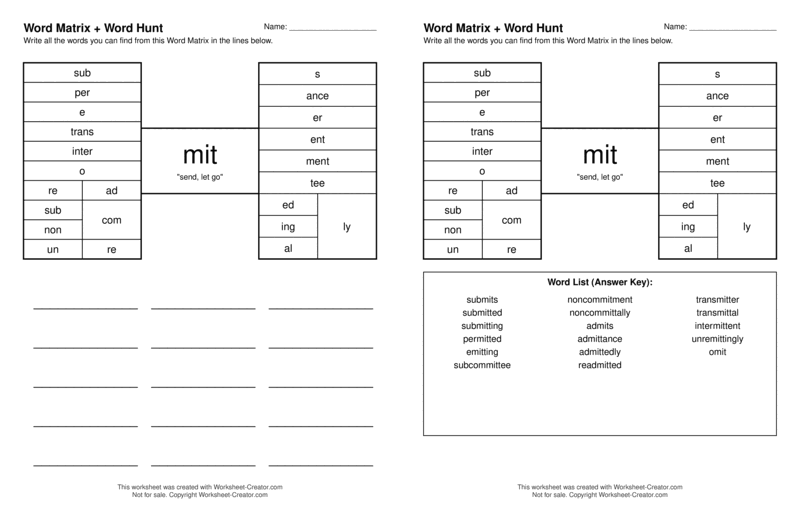
- Morpheme Mapping/Word Matrices: These are graphic organizers that help students break down and analyze words into roots, prefixes, and suffixes. A Word Matrix shows the morphemes that can be combined to make new words; the base or root goes in the middle, prefixes on the left, and suffixes on the right. You can download our pre-made collection of 29 morphology word matrices or create your own directly in Worksheet Creator:
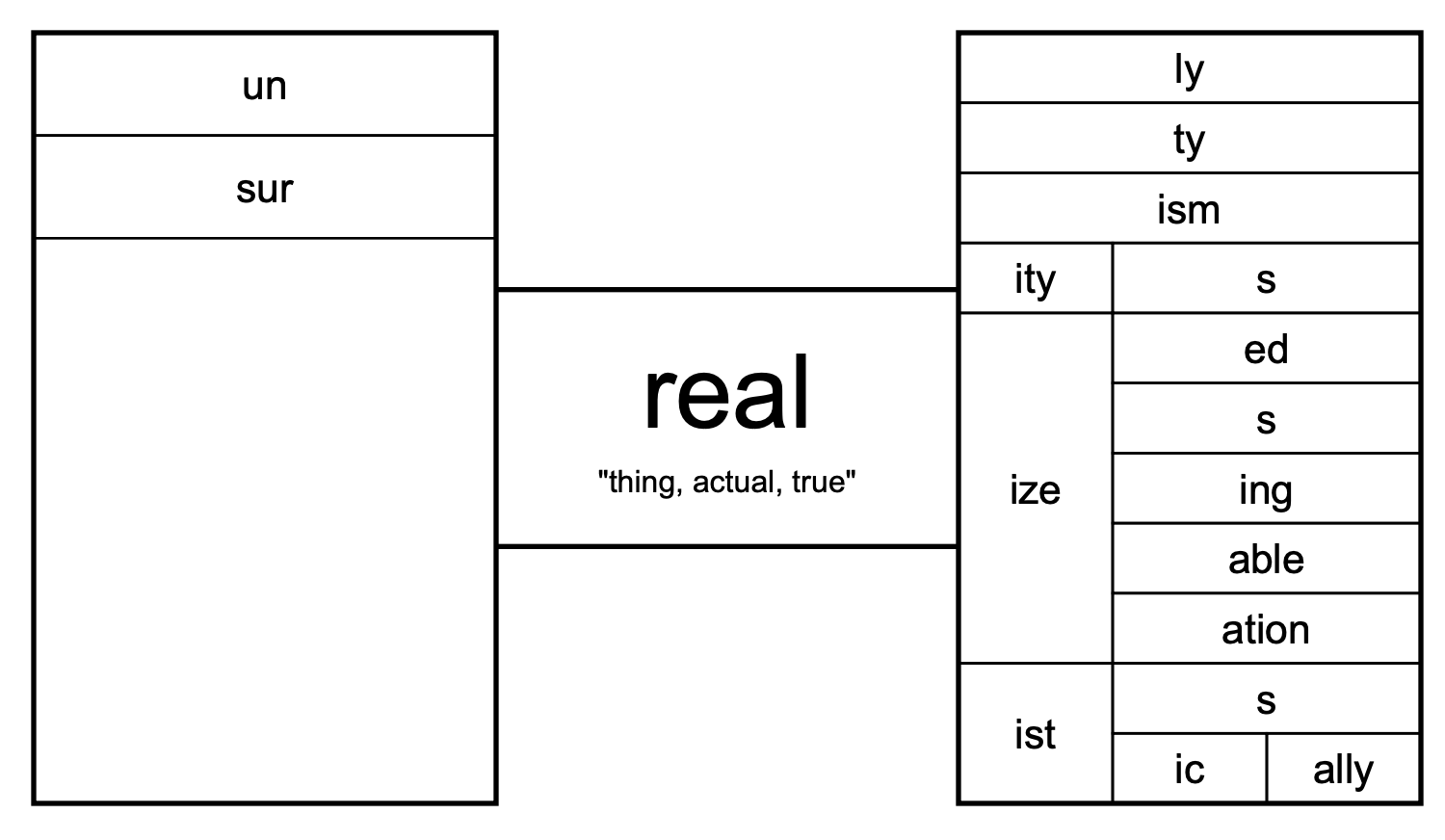
Example of a Word Matrix for the root real.
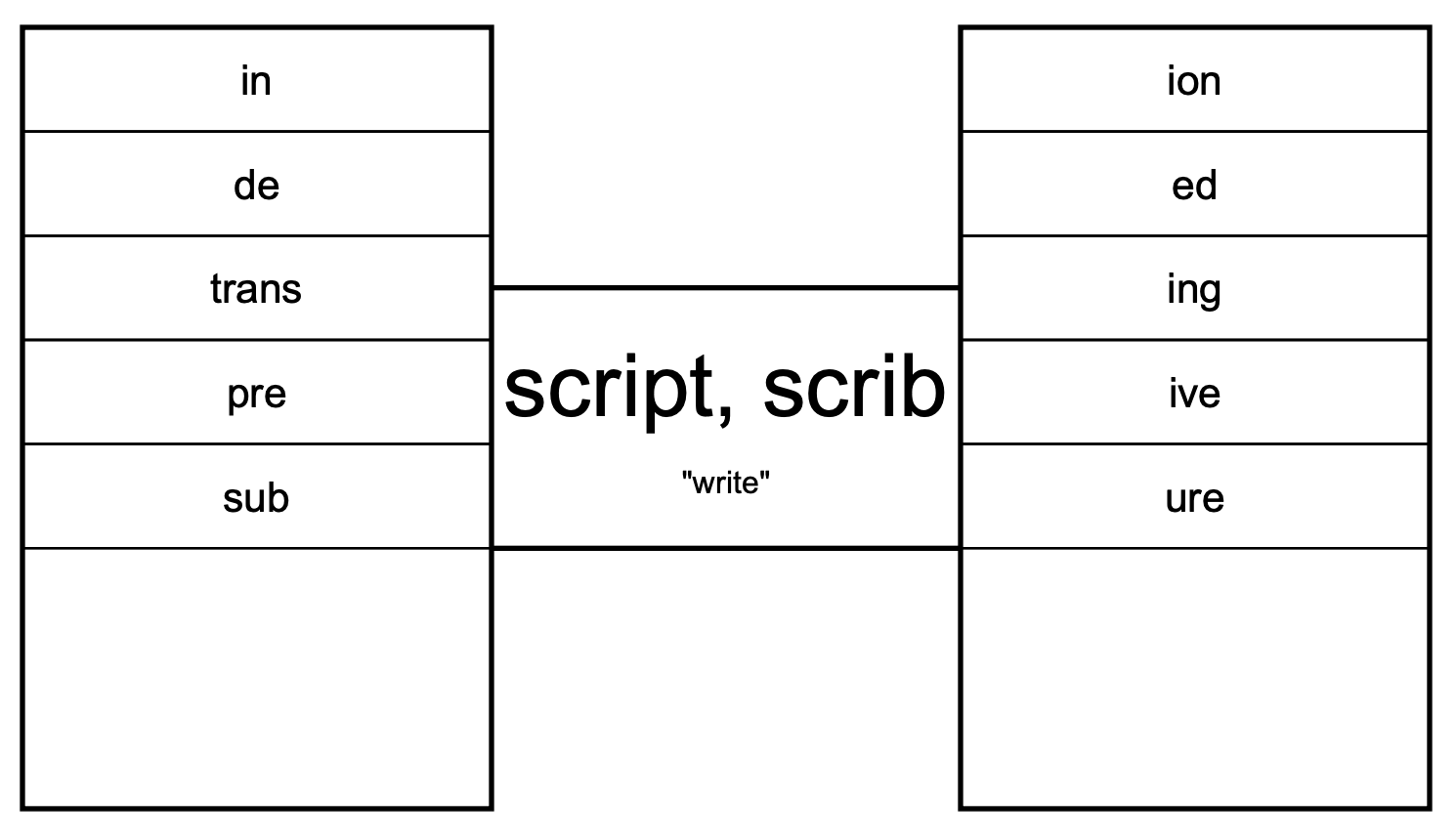
Example of a Word Matrix for the root script.
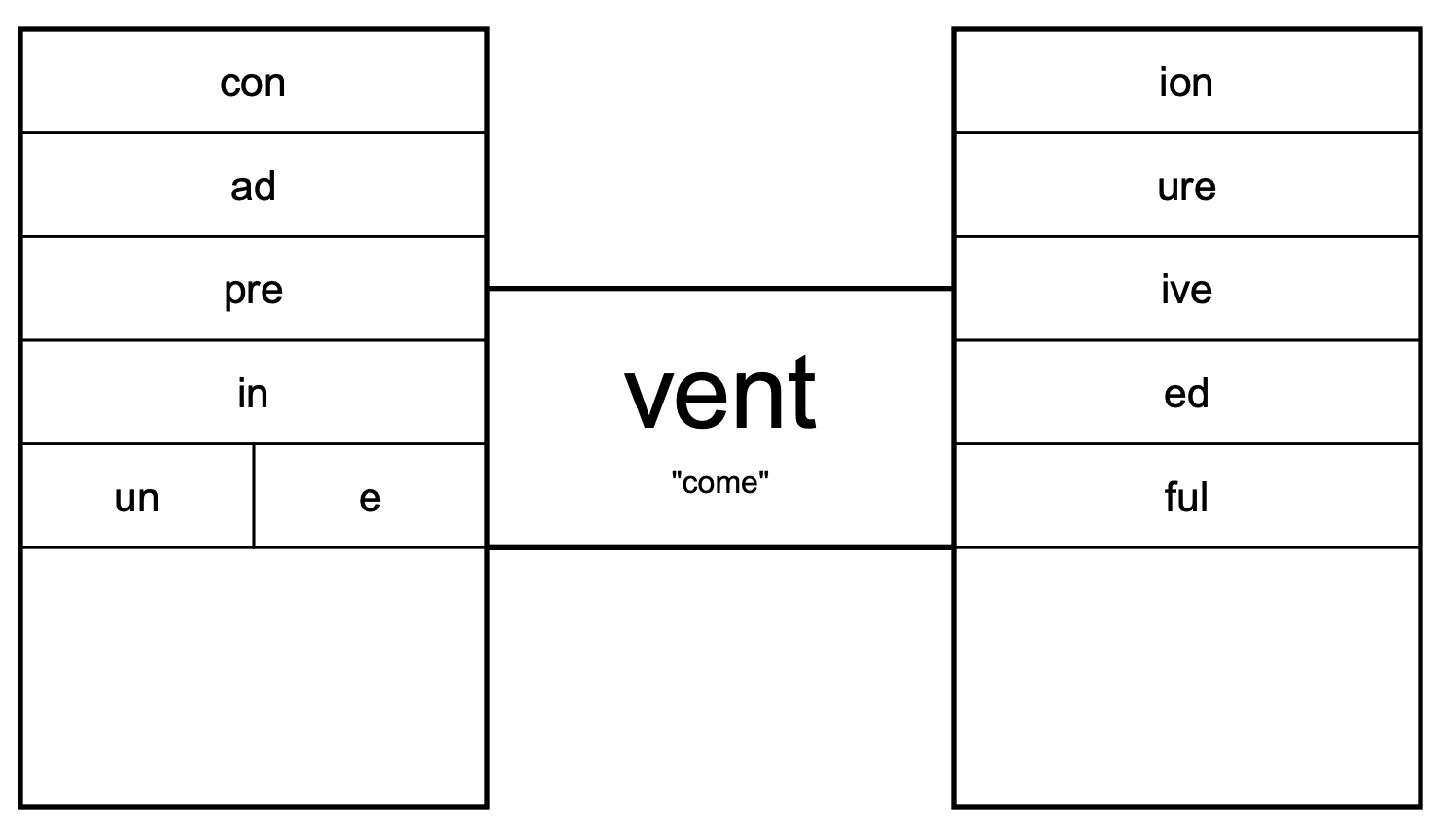
Example of a Word Matrix for the root vent.
- Word Sums: Used alongside word matrices, word sums show the correct way to combine morphemes to spell a word (e.g., in- + vis + -ible = invisible).
Classroom Activities
- Mix and Match: Use note cards to match base words with suffixes (e.g., -s, -ed, -es, -ing) to decide which combinations work grammatically and require spelling changes.
- Expand a Word: Mixing and matching different prefixes and suffixes to build new words from the same base. Discuss how the meaning changes with each addition (e.g., reheat means heat again).
- Suffix Search: Have students go on a word hunt in connected text to underline base words and circle suffixes.
- Context Integration: Combine explicit vocabulary instruction with using rich texts and multiple contexts. Use activities like moving the suffix -s around in simple sentences to illustrate how it makes a noun plural or shows verb agreement.
Ready to teach morphology?
Download our collection of 29 morphology word matrix activity sheets for common Latin roots. Available to all paid subscribers.
Resources
Related Tools
- Download our collection of 29 Latin Root Word Matrices
- Create Word Matrix and Word Hunt activity worksheets
- Discover Word Matrix activity worksheets created by other teachers
- See Morphology resources on Teachers Pay Teachers
References
- Morphology (linguistics) on Wikipedia
- Kirby, John & Deacon, Hélène & Bowers, Peter & Izenberg, Leah & Wade-Woolley, Lesly & Parrila, Rauno. (2011). Children’s morphological awareness and reading ability. Reading and Writing. 25. 389-410. 10.1007/s11145-010-9276-5.
- What should morphology instruction look like? by Tim Shanahan
- Baumann, James & Edwards, Elizabeth & Boland, Eileen & Olejnik, S.F. & Kame’enui, Edward. (2003). Vocabulary Tricks: Effects of Instruction in Morphology and Context on Fifth-Grade Students’ Ability to Derive and Infer Word Meanings. American Educational Research Journal - AMER EDUC RES J. 40. 447-494. 10.3102/00028312040002447.
- Addressing the middle school reading crisis, by Miah Daughtery, EdD
- What is morphology and why does it matter, by Dr. Kristen Killian
- High-Frequency Prefixes, Suffixes and Roots, by White, Sowell, and Yanagihara (The Reading Teacher, 42, p. 306)
- Teaching Morphology to Beginning Readers