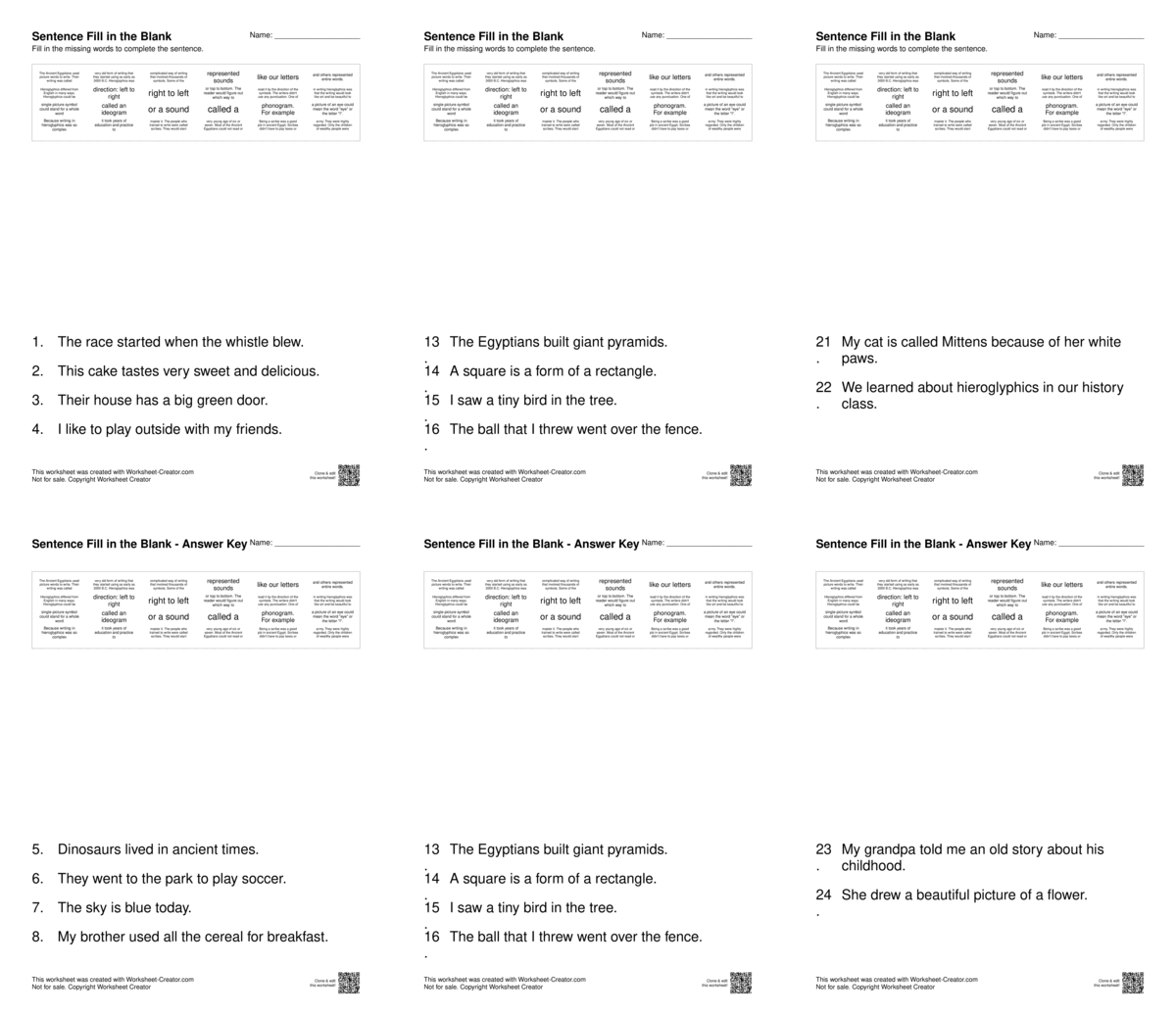
Here is what this worksheet looks like
Preview
This preview will loop through all of the pages in the PDF.
The downloadable PDF will be full-sized and look great when printed.
What do you think?
This copy will be saved to your account. If you don't have an account, you will be able to create one for free.
You will be able to customize the worksheet for free.
Once you like it, you can purchase, download, and print it.
The price for each worksheet is $3.99.
Or, purchase a full year of worksheet downloads for $39.99.
Don't like it? Go back to see more worksheets in the Sentence Fill in the Blank Store.
Words used: The Ancient Egyptians used picture words to write. Their writing was called hieroglyphics. It is a, very old form of writing that they started using as early as 3000 B.C. Hieroglyphics was a very, complicated way of writing that involved thousands of symbols. Some of the symbols, represented sounds, like our letters, and others represented entire words., Hieroglyphics differed from English in many ways. Hieroglyphics could be written in almost any, direction: left to right, right to left, or top to bottom. The reader would figure out which way to, read it by the direction of the symbols. The writers didn't use any punctuation. One of the goals, in writing hieroglyphics was that the writing would look like art and be beautiful to look at. A, single picture symbol could stand for a whole word, called an ideogram, or a sound, called a, phonogram. For example, a picture of an eye could mean the word "eye" or the letter "I"., Because writing in hieroglyphics was so complex, it took years of education and practice to, master it. The people who trained to write were called scribes. They would start training at a, very young age of six or seven. Most of the Ancient Egyptians could not read or write., Being a scribe was a good job in ancient Egypt. Scribes didn't have to pay taxes or enter the, army. They were highly regarded. Only the children of wealthy people were allowed to train as, scribes., The Ancient Egyptians often wrote on tablets or walls, but they also wrote on a type of paper, called papyrus. Paper was made from a tall, reedlike plant called papyrus. The Egyptians would, use strips from the plant's inner stem to make the paper. They would make two layers of strips;, one horizontal and the other vertical. Then they would cover it in a linen cloth and apply, pressure with a mallet or stones. The strips would bind together over time, making a single flat, sheet to write on., In 1799, a French soldier found a special stone in the city of Rosetta, Egypt. This stone had the, same message written in both hieroglyphics and Greek. This was important because it helped, people to translate what the hieroglyphics said. Then the stone could be used to help translate, other hieroglyphics as well., Sometimes scribes used a faster, short form of hieroglyphics on papyrus called hieratic. When, the Greeks took over Egypt, many scribes had to learn Greek as well. A very famous scribe was, Imhotep. He became high priest of the Egyptian sun god and designed the first pyramid., The Ancient Egyptians used picture words to write. Their writing was called hieroglyphics. It is a, very old form of writing that they started using as early as 3000 B.C. Hieroglyphics was a very, complicated way of writing that involved thousands of symbols. Some of the symbols, represented sounds, like our letters, and others represented entire words., Hieroglyphics differed from English in many ways. Hieroglyphics could be written in almost any, direction: left to right, right to left, or top to bottom. The reader would figure out which way to, read it by the direction of the symbols. The writers didn't use any punctuation. One of the goals, in writing hieroglyphics was that the writing would look like art and be beautiful to look at. A, single picture symbol could stand for a whole word, called an ideogram, or a sound, called a, phonogram. For example, a picture of an eye could mean the word "eye" or the letter "I"., Because writing in hieroglyphics was so complex, it took years of education and practice to, master it. The people who trained to write were called scribes. They would start training at a, very young age of six or seven. Most of the Ancient Egyptians could not read or write., Being a scribe was a good job in ancient Egypt. Scribes didn't have to pay taxes or enter the, army. They were highly regarded. Only the children of wealthy people were allowed to train as, scribes., The Ancient Egyptians often wrote on tablets or walls, but they also wrote on a type of paper, called papyrus. Paper was made from a tall, reedlike plant called papyrus. The Egyptians would, use strips from the plant's inner stem to make the paper. They would make two layers of strips;, one horizontal and the other vertical. Then they would cover it in a linen cloth and apply, pressure with a mallet or stones. The strips would bind together over time, making a single flat, sheet to write on., In 1799, a French soldier found a special stone in the city of Rosetta, Egypt. This stone had the, same message written in both hieroglyphics and Greek. This was important because it helped, people to translate what the hieroglyphics said. Then the stone could be used to help translate, other hieroglyphics as well., Sometimes scribes used a faster, short form of hieroglyphics on papyrus called hieratic. When, the Greeks took over Egypt, many scribes had to learn Greek as well. A very famous scribe was, Imhotep. He became high priest of the Egyptian sun god and designed the first pyramid.
For grade level: 5th Grade
Created by: I. Ericsson
This worksheet was created with the Sentence Fill in the Blank template. Learn more about this template.